
What is Express Entry Canada?
CRS = Age + Education + Language + Work Experience + Adaptability
Express Entry Canada is an online immigration system used by the Canadian government to manage applications for skilled workers. It is one of the fastest and most popular pathways for obtaining Canada PR.
The Express Entry system manages applications under:
- 🔸 Federal Skilled Worker Program (FSWP)
- 🔸 Federal Skilled Trades Program (FSTP)
- 🔸 Canadian Experience Class (CEC)
- 🔸 Age
- 🔸 Education
- 🔸 Language skills
- 🔸 Work experience
- 🔸 Adaptability
What is PNP Canada?
The Provincial Nominee Program (PNP) allows Canadian provinces and territories to nominate immigrants based on local labor market needs. Each province has its own immigration streams and requirements. Popular provinces with PNP programs include:- 🔸 Ontario
- 🔸 British Columbia
- 🔸 Alberta
- 🔸 Saskatchewan
- 🔸 Manitoba
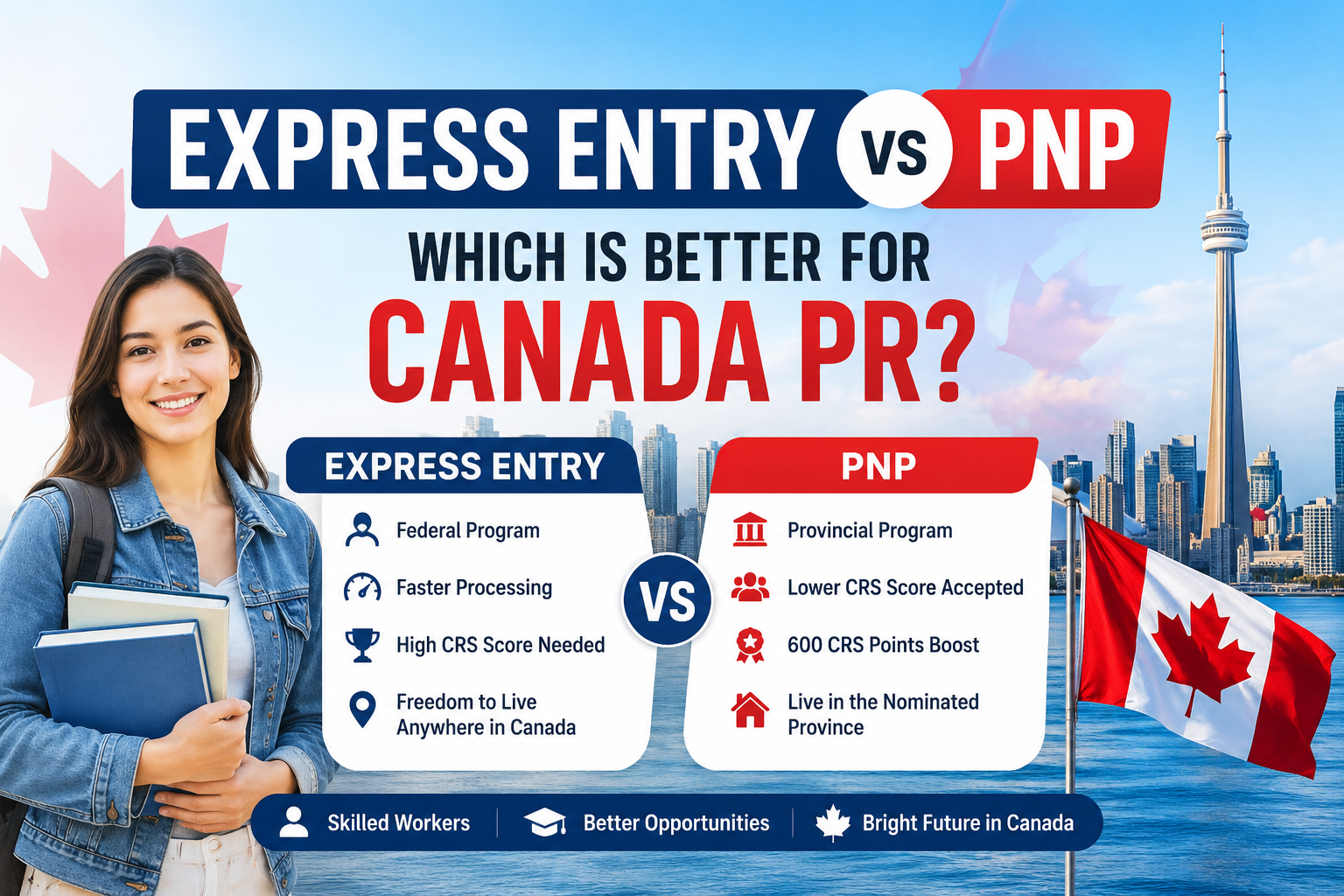
Main Difference Between Express Entry vs PNP
| Feature | Express Entry | PNP |
|---|---|---|
| Managed By | Federal Government | Provincial Government |
| Processing Time | Faster | Slightly Longer |
| CRS Score Required | Usually Higher | Lower CRS Accepted |
| Job Offer | Not always required | Sometimes required |
| Province Restriction | Flexible | Must settle in nominating province |
| PR Chances | Competitive | Higher with nomination |
Eligibility for Express Entry Canada
To apply under Express Entry Canada, applicants usually need:- 🔸 Skilled work experience
- 🔸 Language test results (IELTS/CELPIP)
- 🔸 Educational Credential Assessment (ECA)
- 🔸 Proof of funds
- 🔸 Strong CRS score
Eligibility for PNP Canada
Eligibility for PNP depends on the province and stream. Common requirements include:- 🔸 Work experience
- 🔸 Education
- 🔸 Language skills
- 🔸 Job offer (for some streams)
- 🔸 Intention to live in the province
- 🔸 International students
- 🔸 Skilled workers
- 🔸 Healthcare professionals
- 🔸 Tech workers
- 🔸 Entrepreneurs
CRS Score in Express Entry vs PNP
CRS score is one of the biggest factors in the Express Entry Canada system.Express Entry
You compete against other candidates in the pool.PNP
If nominated by a province, you receive an additional 600 CRS points, almost guaranteeing an ITA. This is why many applicants with lower CRS scores choose PNP programs.Processing Time: Express Entry vs PNP
Express Entry Processing Time
Express Entry is generally faster. Average processing may take around:- 🔸 6 to 8 months (can vary)
PNP Processing Time
PNP applications may take longer because:- 🔸 Provincial nomination comes first
- 🔸 Federal processing happens later
- 🔸 12 months or more depending on stream
Benefits of Express Entry Canada
- 🔸 Faster Processing
- 🔸 No Province Restriction
- 🔸 Online Application System
- 🔸 Suitable for High CRS Candidates
Benefits of PNP Canada
- 🔸 Lower CRS Score Acceptance
- 🔸 Province-Specific Opportunities
- 🔸 Increased PR Chances
- 🔸 Options for Different Occupations
Express Entry vs PNP – Which is Better?
Express Entry is Better If:
- 🔸 You have a high CRS score
- 🔸 Strong IELTS score
- 🔸 Skilled work experience
- 🔸 Good education credentials
PNP is Better If:
- 🔸 Your CRS score is low
- 🔸 You want province-specific opportunities
- 🔸 You have a job offer in a province
- 🔸 Your occupation is in demand locally
Can You Apply for Both Express Entry and PNP?
Yes, many applicants apply for both programs to increase their chances of Canada PR. You can:- 🔸 Create an Express Entry profile
- 🔸 Apply for eligible PNP streams simultaneously
Best Provinces for PNP in Canada
- 🔸 Ontario
- 🔸 British Columbia
- 🔸 Alberta
- 🔸 Saskatchewan
Common Mistakes in Canada PR Applications
Many applicants face delays or rejection because of:- 🔸 Incorrect documents
- 🔸 Weak language scores
- 🔸 Incomplete applications
- 🔸 Low CRS score
- 🔸 Wrong immigration stream selection
How CHD Immigration Can Help
CHD Immigration provides guidance for:- 🔸 Express Entry Canada
- 🔸 Provincial Nominee Program
- 🔸 Canada PR applications
- 🔸 CRS score evaluation
- 🔸 Immigration documentation
- 🔸 PNP application support
Tips to Improve Your Canada PR Chances
- 🔸 Improve IELTS score
- 🔸 Gain more work experience
- 🔸 Complete higher education
- 🔸 Apply for PNP programs
- 🔸 Keep documents updated
- 🔸 Create a strong Express Entry profile