
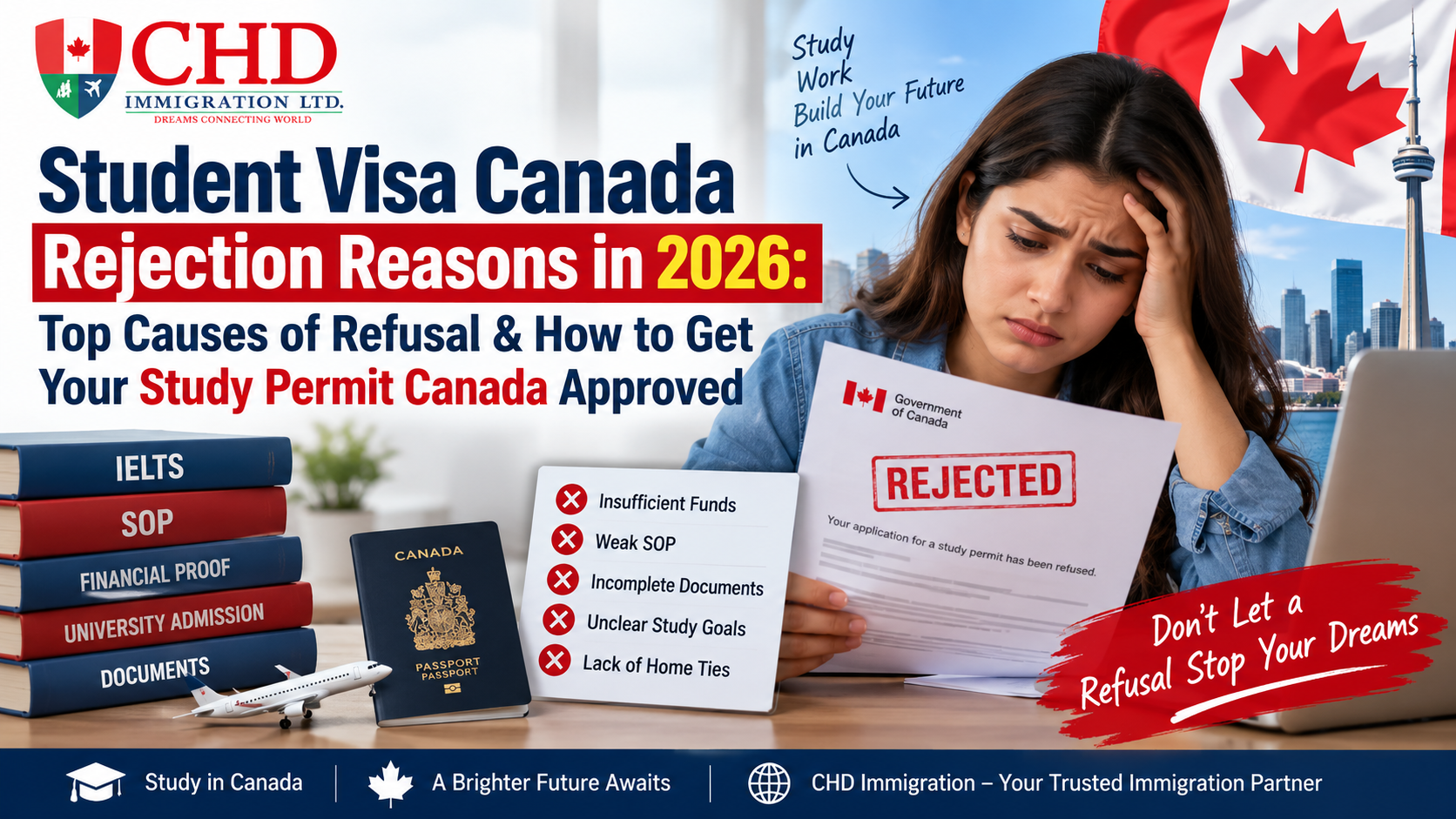
Canada remains one of the most popular study destinations for international students due to its world-class education system, multicultural environment, and excellent post-graduation opportunities. However, not every student visa Canada application gets approved. Every year, thousands of applicants face Canada study visa rejection because of documentation issues, financial concerns, weak study plans, or failure to meet immigration requirements.
Understanding why applications are refused can significantly improve your chances of obtaining a study permit Canada successfully. In this guide, CHD Immigration explains the most common reasons for rejection and provides practical solutions to strengthen your application.
According to Canadian immigration requirements, applicants must demonstrate sufficient financial support, possess a valid Letter of Acceptance (LOA), meet eligibility requirements, and convince immigration officers that they intend to leave Canada upon completion of their studies.
What Is a Canada Study Permit?
Before discussing rejection reasons, it’s important to understand the difference between a student visa Canada and a study permit Canada.
A study permit is the official authorization that allows international students to study at a Designated Learning Institution (DLI) in Canada. Most students require a valid acceptance letter from a DLI and must apply before traveling to Canada.
Why Does Canada Study Visa Rejection Happen?
Canadian immigration officers carefully evaluate each application to ensure the student is genuinely coming to Canada for educational purposes and meets all eligibility criteria.
The most common reasons for Canada study visa rejection include:
- Insufficient financial proof
- Weak Statement of Purpose (SOP)
- Incomplete documentation
- Unclear study goals
- Weak home-country ties
- Inconsistent information
- Medical or criminal inadmissibility
- Invalid educational background
- Doubts regarding temporary resident intent
- Missing required immigration documents
1. Insufficient Proof of Funds
One of the leading reasons for study permit Canada refusal is inadequate financial documentation.
Canadian immigration authorities must be convinced that you can pay for:
- Tuition fees
- Living expenses
- Accommodation costs
- Return travel expenses
Applicants who submit unclear bank statements, unexplained deposits, or insufficient funds often receive refusals. Canadian regulations specifically require proof of sufficient financial support.
How to Avoid This
✔ Maintain consistent bank balances
✔ Submit education loan documents if applicable
✔ Provide sponsor income proof
✔ Include GIC and tuition payment receipts
✔ Explain large financial transactions
2. Weak Statement of Purpose (SOP)
Your SOP is one of the most important documents in a student visa Canada application.
A poorly written SOP can make visa officers question:
- Your study intentions
- Career objectives
- Program selection
- Future plans
Many students submit generic SOPs copied from the internet, which can negatively impact approval chances.
How to Avoid This
Create a personalized SOP that explains:
- Why you selected Canada
- Why you chose your institution
- Career opportunities after graduation
- How the program aligns with your educational background
At CHD Immigration, professionally structured SOPs are prepared according to current immigration requirements.
3. Lack of Strong Home Country Ties
Visa officers must believe that you will return to your home country after completing your studies.
Canadian regulations require applicants to demonstrate that they will leave Canada once their authorized stay ends.
Weak Home Ties Examples
- No family responsibilities
- No property ownership
- No employment prospects
- Unclear future plans
How to Avoid This
Provide evidence of:
- Family connections
- Property ownership
- Business interests
- Career opportunities in your home country
4. Choosing an Irrelevant Course
A mismatch between your previous education and selected program may create concerns.
For example:
- Engineering graduate applying for an unrelated diploma
- MBA graduate applying for an entry-level certificate
- Significant educational downgrades
Officers may question the genuine purpose of your studies.
How to Avoid This
Clearly explain:
- Academic progression
- Career benefits
- Industry relevance
- Future employment opportunities
5. Incomplete Application Documents
Missing documents are another major reason for Canada study visa rejection.
Canadian immigration authorities require a complete application package, and missing information can delay processing or result in refusal.
Common Missing Documents
- Passport copies
- Academic transcripts
- IELTS/PTE results
- Letter of Acceptance
- Financial documents
- Provincial Attestation Letter (PAL)
How to Avoid This
Use a professional checklist before submission and verify all uploaded documents.
6. Missing Provincial Attestation Letter (PAL)
Recent immigration updates have made the Provincial Attestation Letter (PAL) mandatory for many applicants.
Applications submitted without required PAL documentation may be refused or returned.
How to Avoid This
- Confirm PAL requirements for your province
- Obtain PAL before submitting your application
- Upload documents correctly
7. Poor Academic Performance
Low grades do not automatically cause refusal, but they can raise concerns.
Officers evaluate whether you are capable of successfully completing the chosen program.
How to Avoid This
If your academics are weak:
- Explain gaps honestly
- Highlight work experience
- Demonstrate skill development
- Show career progression
8. Misrepresentation or False Information
Submitting fake documents is one of the most serious mistakes.
Examples include:
- Fake bank statements
- Forged employment letters
- Incorrect academic records
- False travel history
Immigration authorities actively verify information and fraudulent documents can lead to refusal and future immigration complications.
How to Avoid This
✔ Submit genuine documents only
✔ Verify every detail before submission
✔ Work with authorized immigration professionals
9. Medical or Criminal Inadmissibility
Certain medical conditions or criminal records can affect eligibility.
Applicants may need:
- Medical examinations
- Police clearance certificates
Canadian immigration regulations require applicants to meet admissibility requirements.
How to Avoid This
- Complete medical examinations on time
- Declare previous legal issues honestly
- Provide supporting documentation
10. Unclear Purpose of Visit
This is among the most common reasons for study permit Canada refusal.
If officers believe your primary objective is immigration rather than education, they may refuse the application. Immigration officers assess whether the purpose of study is genuine.
How to Avoid This
Show:
- Strong academic goals
- Relevant course selection
- Career plans after graduation
- Genuine student intentions
What To Do After a Canada Study Visa Rejection?
Receiving a refusal does not mean your Canadian education journey is over.
Steps to Take
- Review the refusal letter carefully
- Identify refusal reasons
- Correct weaknesses in your application
- Gather stronger supporting documents
- Rewrite your SOP if necessary
- Reapply with professional guidance
Many students successfully obtain approval after addressing the issues that caused their initial Canada study visa rejection.
How CHD Immigration Helps Improve Study Permit Canada Approval Chances
Applying for a student visa Canada requires detailed planning, accurate documentation, and a strong application strategy.
At CHD Immigration, our experts assist students with:
- Study permit Canada applications
- SOP preparation
- University and college admissions
- Visa documentation review
- Financial documentation guidance
- Refusal case reapplications
- Canada immigration consultation
Our goal is to help students submit complete, accurate, and compelling applications that meet current Canadian immigration requirements.
Final Thoughts
A Canada study visa rejection can be disappointing, but most refusals happen because of avoidable mistakes. Proper financial documentation, a strong SOP, relevant course selection, and complete paperwork can dramatically improve your approval chances.
If you’re planning to apply for a student visa Canada or need assistance after a refusal, CHD Immigration can guide you through every step of the process and help strengthen your study permit Canada application.
FAQs About Student Visa Canada
Q1. What is the most common reason for student visa Canada rejection?
Ans. Insufficient proof of funds and unclear study intentions are among the most common reasons for refusal.
Q2. Can I apply again after Canada study visa rejection?
Ans. Yes. You can reapply after addressing the concerns mentioned in your refusal letter and strengthening your application.
Q3. Does IELTS affect study permit Canada approval?
Ans. Yes. Low language proficiency scores may raise concerns regarding your ability to successfully complete studies in Canada.
Q4. How long should I wait before reapplying after refusal?
Ans. There is no mandatory waiting period. However, it is recommended to address all refusal reasons before submitting a new application.
Q5. Can CHD Immigration help with refused study permit applications?
Ans. Yes. CHD Immigration provides professional support for refusal case assessments, documentation improvements, SOP writing, and reapplication strategies.