
Canada continues to be one of the most attractive destinations for skilled professionals, tradespeople, healthcare workers, IT specialists, and international talent seeking career growth abroad. With labor shortages across multiple industries, the demand for foreign workers remains strong in 2026.
However, many applicants are confused about the difference between a Work Permit Canada and an LMIA Work Permit. While both allow foreign nationals to work legally in Canada, the application process, employer requirements, flexibility, and eligibility criteria are very different.
Understanding these differences is essential before applying for a Canada Work Visa. In this comprehensive guide, CHD Immigration explains everything you need to know about LMIA-based and non-LMIA work permits, helping you choose the right pathway for your Canadian employment goals.
Understanding Work Permit Canada
A Work Permit Canada is an authorization issued by Immigration, Refugees and Citizenship Canada (IRCC) that allows foreign nationals to work legally in Canada for a specified period.
Depending on your situation, Canadian work permits may be:
- Employer-specific work permits
- Open work permits
- LMIA-based work permits
- LMIA-exempt work permits
- Post-Graduation Work Permits (PGWP)
- Spousal Open Work Permits
A Canadian work permit serves as a legal authorization to work but does not automatically grant permanent residency.
What Is an LMIA Work Permit?
An LMIA Work Permit is a type of employer-specific work permit that requires a Labour Market Impact Assessment (LMIA) before the worker can apply.
The LMIA is issued by Employment and Social Development Canada (ESDC) and confirms that:
- No Canadian citizen is available for the position
- No permanent resident can fill the role
- Hiring a foreign worker will not negatively affect the Canadian labor market
Once the employer receives a positive LMIA, the foreign worker can apply for a Canada Work Visa and work permit.
What Is a Non-LMIA Work Permit?
A non-LMIA work permit allows eligible foreign workers to work in Canada without requiring an employer to obtain an LMIA.
Common LMIA-exempt categories include:
- Post-Graduation Work Permit (PGWP)
- Spousal Open Work Permit
- International Mobility Program (IMP)
- Intra-Company Transfer
- Free Trade Agreement Programs
- Francophone Mobility Program
These permits are often faster and less complicated than LMIA-based applications.
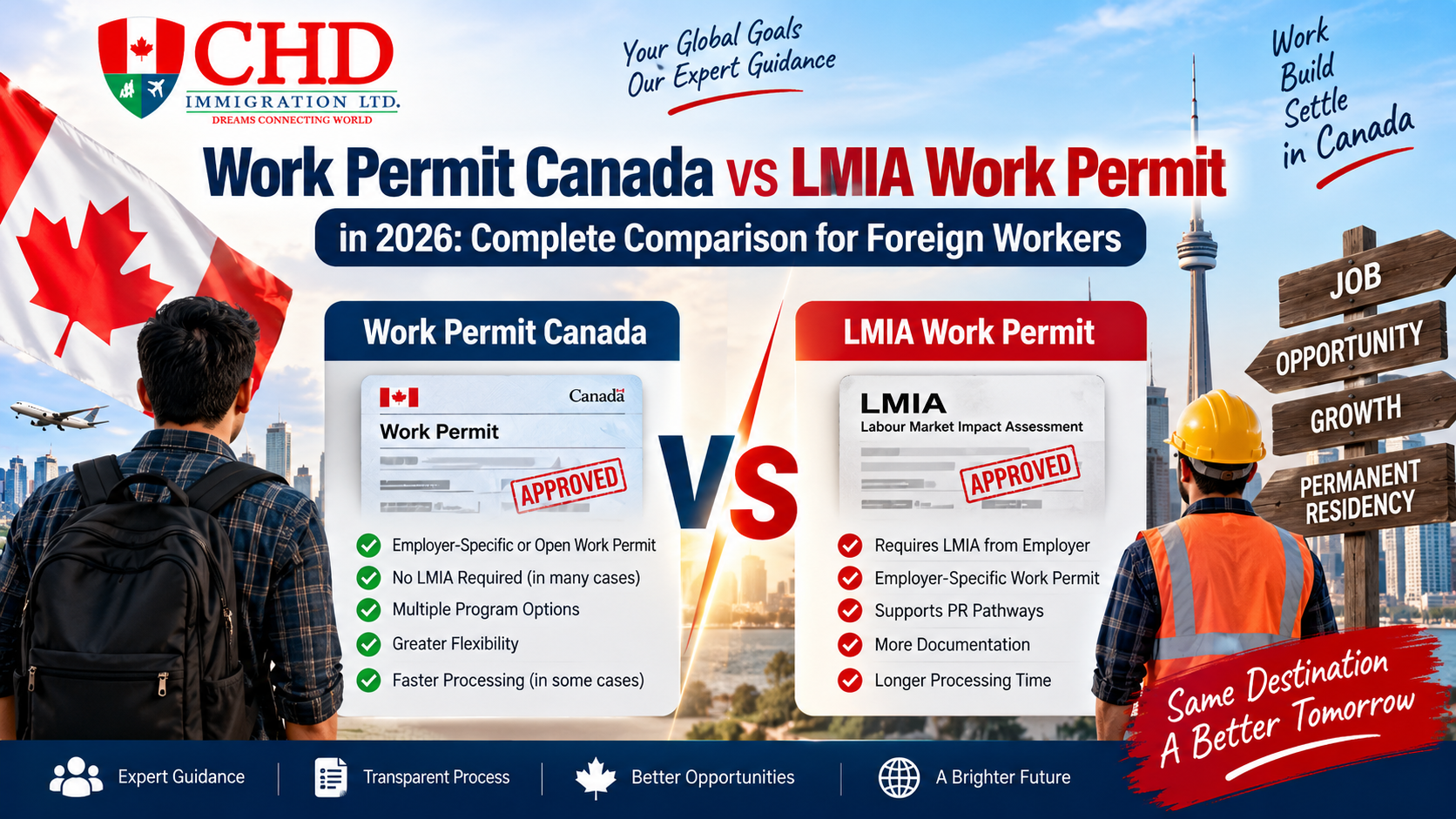
Work Permit Canada vs LMIA Work Permit: Key Differences
| Feature | Work Permit Canada | LMIA Work Permit |
| LMIA Required | Not Always | Yes |
| Employer Restriction | May be Open | Employer-Specific |
| Flexibility | High | Limited |
| Job Change Allowed | Often Yes | Usually No |
| Processing Complexity | Moderate | Higher |
| Employer Involvement | Sometimes | Significant |
| Application Cost | Varies | Additional LMIA Costs |
| PR Benefits | Depends on Program | Often Supports PR |
Understanding these distinctions is crucial when selecting the right Canada Work Visa pathway.
How Does the LMIA Process Work?
Before hiring a foreign worker, Canadian employers must prove they attempted to recruit Canadian citizens or permanent residents.
LMIA Process Steps
1. Job Advertisement
The employer advertises the position across approved recruitment platforms.
2. LMIA Application
The employer submits an LMIA request to ESDC.
3. Government Assessment
Authorities evaluate:
- Recruitment efforts
- Wage standards
- Labor shortages
- Employer compliance history
4. Positive LMIA Issued
If approved, the employer receives a positive LMIA.
5. Worker Applies
The foreign worker then submits a Work Permit Canada application using the approved LMIA.
Advantages of an LMIA Work Permit
Many applicants pursue an LMIA Work Permit because it offers several long-term immigration benefits.
Benefits Include
✔ Access to genuine Canadian job opportunities
✔ Strong support for Express Entry profiles
✔ Additional CRS points in some situations
✔ Increased chances of permanent residency pathways
✔ Employer-sponsored immigration opportunities
✔ Canadian work experience benefits
For many skilled workers, an LMIA-supported job offer becomes a stepping stone toward permanent residence.
Advantages of a Non-LMIA Work Permit Canada
Not every foreign worker requires an LMIA.
Major Benefits
✔ Faster processing
✔ Less employer involvement
✔ Greater job flexibility
✔ Easier mobility within Canada
✔ Ability to change employers in some cases
✔ Reduced administrative burden
Many international graduates and spouses of eligible workers choose this route because of its flexibility.
Who Should Apply for an LMIA Work Permit?
An LMIA Work Permit may be the right choice if:
- You have a Canadian employer willing to sponsor you
- Your occupation is experiencing labor shortages
- You want to strengthen future PR applications
- You possess specialized skills in demand
- You have received a valid job offer from Canada
Popular sectors include:
- Healthcare
- Construction
- Trucking
- Agriculture
- Hospitality
- Manufacturing
- Information Technology
Who Should Apply for a Non-LMIA Work Permit?
You may qualify for a non-LMIA Work Permit Canada if:
- You recently graduated from a Canadian institution
- You are the spouse of an eligible worker
- You qualify under international agreements
- You are transferring within a multinational company
- You meet International Mobility Program requirements
These permits offer more freedom and fewer restrictions.
Common Reasons for Canada Work Visa Refusal
Whether applying through LMIA or non-LMIA pathways, refusals can occur.
Common Reasons Include
- Incomplete documentation
- Invalid job offers
- Employer compliance concerns
- Insufficient qualifications
- Financial concerns
- Immigration history issues
- Inconsistent application information
- Failure to demonstrate eligibility
Proper preparation significantly improves approval chances.
Can an LMIA Work Permit Lead to Permanent Residency?
Yes.
One of the biggest advantages of an LMIA Work Permit is its potential contribution toward Canadian permanent residency programs.
Many workers eventually transition through:
Express Entry
Skilled workers can use Canadian work experience to improve their CRS scores.
Provincial Nominee Programs (PNPs)
Many provinces prioritize candidates already employed within the province.
Canadian Experience Class (CEC)
Eligible workers with Canadian work experience may qualify for permanent residency.
This makes the LMIA Work Permit a strategic option for long-term immigration goals.
Processing Time: LMIA Work Permit vs Work Permit Canada
Processing times vary based on:
- Country of application
- Occupation
- Government workload
- Program stream
- Document completeness
Generally:
LMIA Work Permit
- Requires employer processing first
- Additional LMIA review stage
- Longer overall timeline
Non-LMIA Work Permit
- Fewer approval stages
- Faster processing in many cases
- Less employer documentation
Applicants should always check current processing updates before applying.
How CHD Immigration Helps With Canada Work Visa Applications
Navigating Canadian immigration programs can be challenging, especially when deciding between an LMIA-based and non-LMIA pathway.
At CHD Immigration, our experienced consultants assist clients with:
- Work Permit Canada applications
- LMIA Work Permit guidance
- Canada Work Visa documentation
- Employer-sponsored immigration support
- Job offer verification
- Application review and submission
- Refusal case assistance
- Permanent residency planning
Our goal is to help foreign workers choose the most suitable immigration pathway while maximizing approval chances.
Final Thoughts
Choosing between a Work Permit Canada and an LMIA Work Permit depends on your qualifications, employment situation, long-term goals, and eligibility.
If you already have a Canadian employer willing to sponsor you, an LMIA Work Permit can provide a strong route toward both employment and future permanent residency. On the other hand, eligible applicants who qualify for LMIA-exempt programs may benefit from faster processing and greater flexibility.
Before applying for any Canada Work Visa, it is important to evaluate your options carefully and ensure all requirements are met.
CHD Immigration can help you identify the best pathway and guide you through every stage of your Canadian work permit application.
Frequently Asked Questions (FAQs)
Q1. What is the difference between Work Permit Canada and LMIA Work Permit?
Ans. A Work Permit Canada is a general authorization to work in Canada, while an LMIA Work Permit specifically requires a positive Labour Market Impact Assessment from a Canadian employer.
Q2. Is LMIA mandatory for every Canada Work Visa?
Ans. No. Many work permits are LMIA-exempt, including PGWP, Spousal Open Work Permits, and certain International Mobility Program streams.
Q3. Can I change employers on an LMIA Work Permit?
Ans. Generally, no. Most LMIA work permits are employer-specific, meaning you must work for the employer listed on your permit.
Q4. Does an LMIA Work Permit help with permanent residency?
Ans. Yes. An LMIA-supported job offer can strengthen eligibility for Express Entry and Provincial Nominee Programs.
Q5. Which option is better: LMIA Work Permit or Open Work Permit?
Ans. It depends on your circumstances. Open work permits offer more flexibility, while LMIA work permits can provide stronger pathways toward permanent residency.