
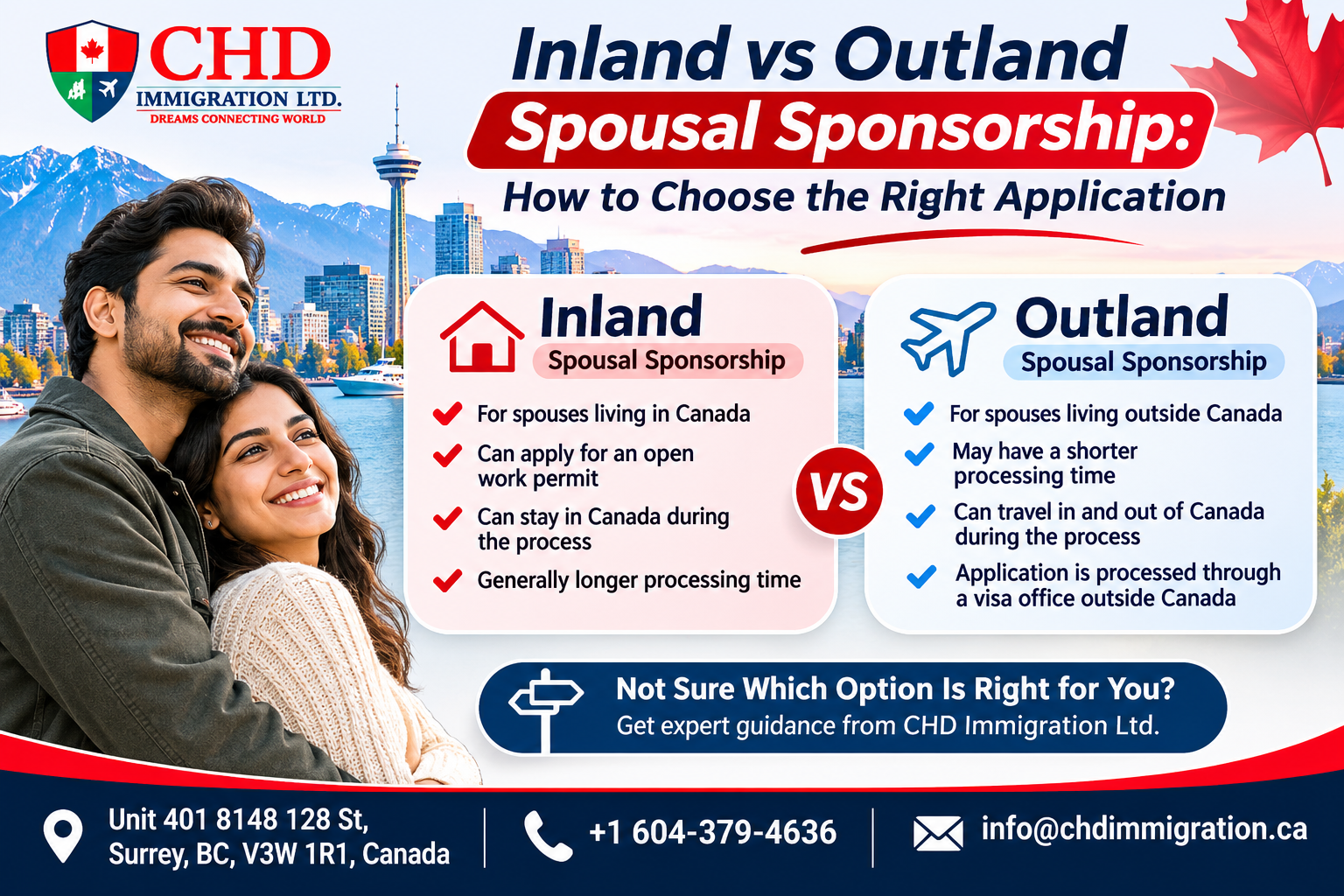
Short answer: inland sponsorship suits couples who already live together in Canada and want the sponsored partner to be able to work while waiting. Outland sponsorship suits couples where the partner lives abroad or needs to travel freely during processing.
Both routes lead to the same result, permanent residence for your spouse or partner. The difference is in what you can do while the application is being processed and what happens if it is refused.
What Is Inland Spousal Sponsorship?
An inland application (the Spouse or Common-Law Partner in Canada class) is for a partner who is living in Canada with the sponsor. Its main advantage is that the sponsored person can usually apply for an open work permit and work for any employer while the application is in process.
The main limits are that the couple must be living together in Canada, and that leaving Canada during processing is risky: if the partner is not allowed back in, the application can fail.
What Is Outland Spousal Sponsorship?
An outland application (the Family Class) is processed through the visa office that serves the partner’s country. It is the normal route when the partner lives abroad, but a partner who is in Canada can also choose it.
The sponsored person can travel in and out of Canada during processing, subject to the usual entry rules. If the application is refused, the sponsor generally has a right to appeal to the Immigration Appeal Division, which is not available for inland applications.
Inland vs Outland: Side-by-Side
| Point | Inland | Outland |
|---|---|---|
| Where the partner lives | In Canada, with the sponsor | Abroad, or in Canada |
| Open work permit while waiting | Usually available | Not part of the application |
| Travel during processing | Risky | Possible |
| Appeal if refused | No appeal to the Appeal Division | Appeal generally available |
Which One Should You Choose?
- Choose inland if your partner is already in Canada with valid status, you live together, and working during the wait matters to your household.
- Choose outland if your partner lives abroad, has to travel for work or family, or if the appeal right is important because your case has complications.
What Evidence Do Both Applications Need?
Officers must be satisfied that the relationship is genuine. Strong applications include a clear relationship history, photographs across time, proof of communication, proof of living together or visits, joint finances where they exist, and letters from people who know the couple. Gaps or contradictions in this evidence are the most common reason for delay.
Frequently Asked Questions
Can we switch from inland to outland after applying?
Not directly. You would withdraw one application and submit the other, so it is worth choosing carefully at the start.
Do common-law partners qualify?
Yes. Common-law partners must show they have lived together continuously for at least one year.
Does the sponsor need a minimum income?
For most spousal sponsorships there is no minimum income requirement, but the sponsor must sign an undertaking and cannot be on social assistance other than for disability.
Read more about our spousal sponsorship service, or ask CHD Immigration to review your relationship evidence before you file.