
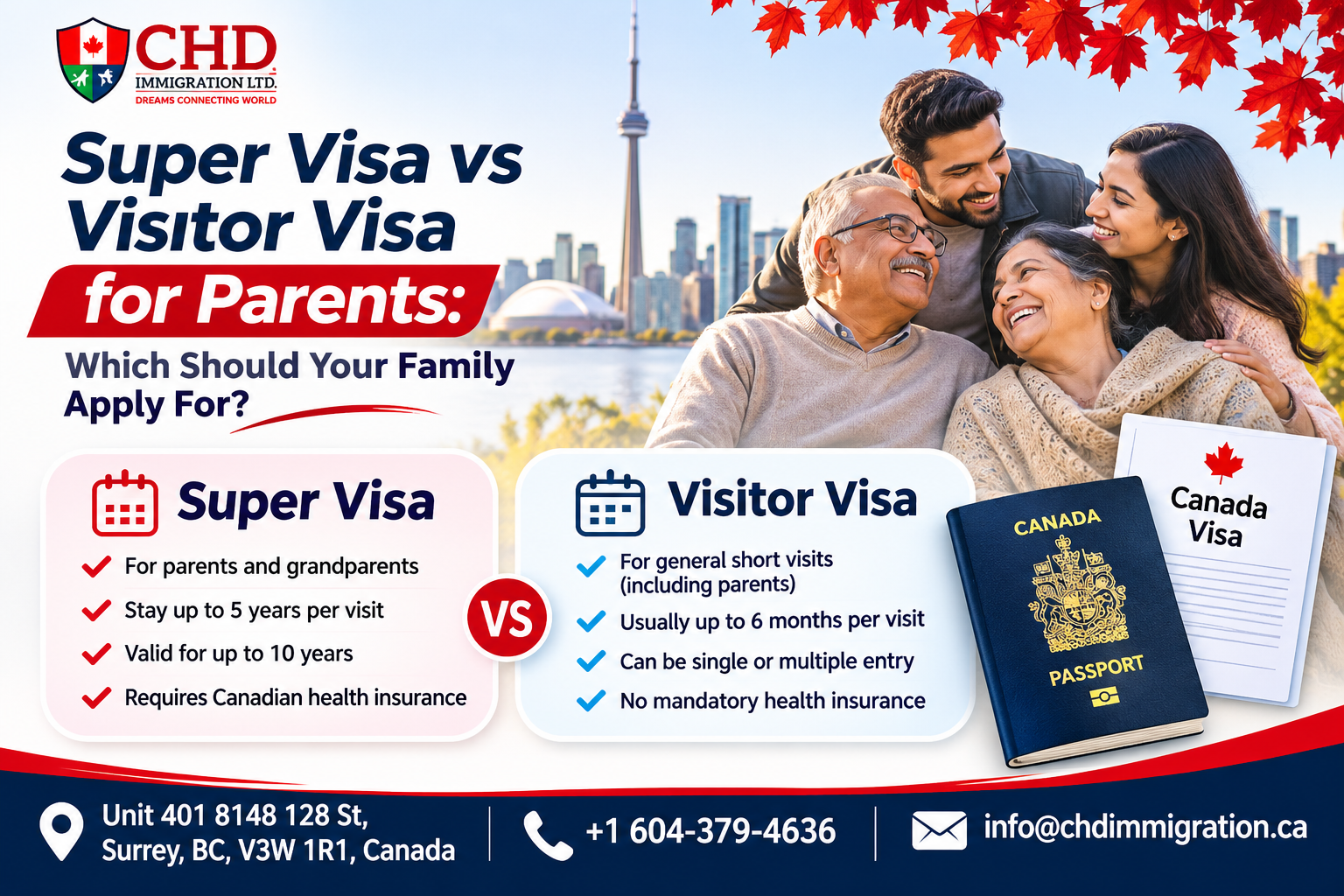
Short answer: choose a Super Visa when your parents or grandparents want to stay in Canada for long periods and you can meet the income and insurance requirements. Choose a regular visitor visa for shorter visits, or when the host does not meet the Super Visa conditions.
Families in Surrey, Vancouver and across Metro Vancouver ask us this question more than almost any other. Both visas let parents visit, but they work differently, and applying for the wrong one wastes time and money.
What Is the Difference Between a Super Visa and a Visitor Visa?
A visitor visa (temporary resident visa) is the standard document for tourists, family visits and short business trips. A visitor is normally allowed to stay for up to six months at a time, and the officer at the border decides the exact period.
A Super Visa is a special visitor visa only for parents and grandparents of Canadian citizens and permanent residents. It allows multiple entries over a period of up to ten years, and each stay can last years instead of months. In exchange, the requirements are stricter.
Who Can Apply for a Super Visa?
- The applicant must be the parent or grandparent of a Canadian citizen or permanent resident.
- The child or grandchild in Canada must sign a letter of invitation and show income at or above the minimum set by the government for the size of their household.
- The applicant must have private medical insurance that meets the Super Visa rules.
- The applicant must complete an immigration medical exam and be admissible to Canada.
Dependants of the parents, such as a younger sibling, cannot be included on a Super Visa. They would need their own visitor visa.
Super Visa vs Visitor Visa: Side-by-Side
| Point | Super Visa | Visitor visa |
|---|---|---|
| Who it is for | Parents and grandparents only | Any eligible visitor |
| Length of each stay | Long stays, measured in years | Usually up to six months |
| Host income requirement | Yes, a set minimum | No fixed minimum, but funds must be shown |
| Medical insurance | Required | Recommended, not required |
| Medical exam | Required | Only in some cases |
When Does a Visitor Visa Make More Sense?
A visitor visa is usually the better choice when your parents plan a visit of a few weeks or months, for example for a wedding, a birth or a graduation. It also fits when the host cannot yet meet the Super Visa income level, or when the cost of long-term insurance is not justified for a short trip.
When Is the Super Visa the Better Choice?
The Super Visa suits parents who want to spend most of the year in Canada, help with grandchildren, or avoid applying to extend their stay every six months. Because the stay is long, families do not have to manage repeated extension applications.
Common Reasons These Applications Are Refused
- The host’s income documents do not clearly show the required amount.
- The insurance policy does not meet the Super Visa conditions.
- The application does not show that the parents will leave Canada at the end of their stay: property, family, pension or other ties to the home country.
- The invitation letter is missing required details.
Frequently Asked Questions
Can my parents work in Canada on a Super Visa?
No. Both the Super Visa and the visitor visa are for visiting only.
Can we apply for a Super Visa if a visitor visa was refused?
Yes, a previous refusal does not block a new application, but the new application must address the reasons for the refusal.
Is the Super Visa the same as sponsoring my parents for PR?
No. The Super Visa is temporary. Permanent residence for parents is a separate family sponsorship process.
Income thresholds and insurance rules are updated by the government, so check the current figures before you apply. CHD Immigration can review your situation and prepare either application.